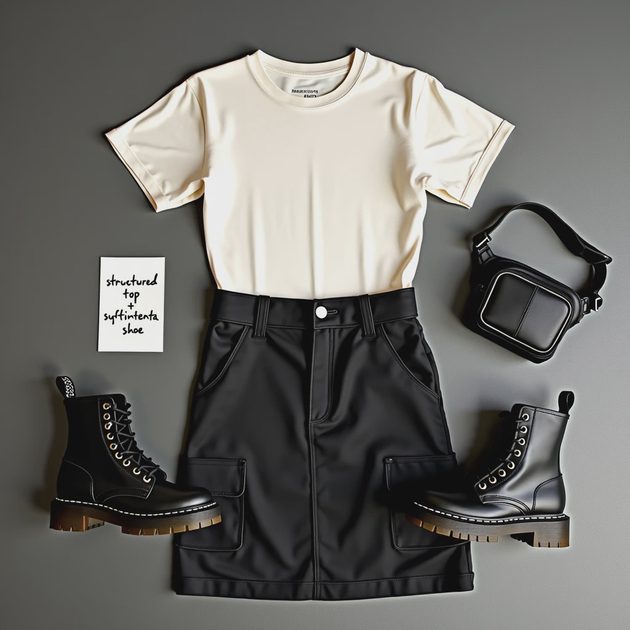
The black cargo skirt sits at an uncomfortable crossroads. It has the utility DNA of cargo pants — the pockets, the hardware, the grounded, functional energy — but in skirt form. That tension is exactly what makes it interesting, and exactly what makes it tricky. Style it one way, and it reads as edgy streetwear with a feminine twist. Style it another, and it veers into "I got lost on the way to a hiking trip" territory.
The forum is split on this piece, which is precisely why it deserves a proper breakdown. Some members swear by the black cargo skirt as a year-round staple. Others bought one, wore it once, and then stared at it hanging in the closet for months before donating it. The difference between the lovers and the regret-buyers almost always comes down to styling — specifically, what the rest of the outfit does to either anchor the skirt or fight against it.
Here's how to land on the right side of that divide.
Why the black cargo skirt is genuinely tricky — name the problem first
Before solving the styling puzzle, it helps to understand why this piece causes so much friction. The issue is that a cargo skirt carries two competing identities at once.
On one hand, it's utilitarian. The pockets, the often cotton-twill or nylon fabric, the military or workwear references — these signal function, toughness, and a "ready for anything" energy. On the other hand, it's a skirt. It exposes the legs, it moves differently than pants, and it carries a baseline level of femininity regardless of how tough the fabric is.
When an outfit resolves this tension, the black cargo skirt becomes one of the most interesting pieces in a streetwear wardrobe. When it doesn't — when the top half and bottom half feel like they belong to different outfits — the skirt reads as confused. Too tough for the feminine pieces, too feminine for the tough pieces.
The goal is to make the tension feel intentional rather than accidental. The skirt should feel like it's in conversation with the rest of the outfit, not arguing with it.
The foolproof formula — structured top, substantial footwear
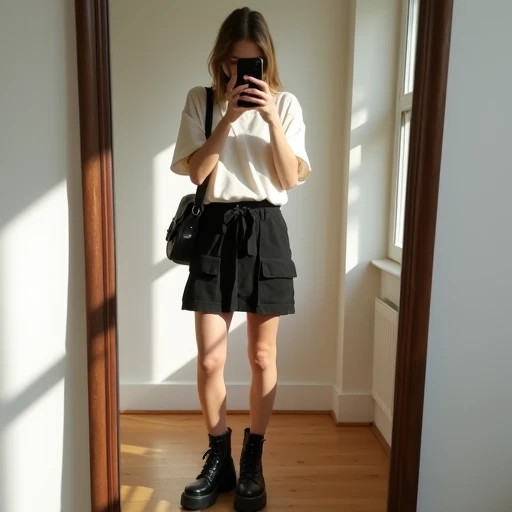
If you're new to the black cargo skirt or have been burned by it before, start here. This combination works almost every time, and it's the foundation that most of the forum's successful cargo-skirt outfits build from.
The top should have structure. A cropped bomber, a boxy denim jacket worn open, a fitted ribbed tank with a sharp neckline, a heavyweight tee with clean shoulders. The structure up top mirrors the skirt's utility energy and creates a cohesive visual language. Soft, flowy, or overly delicate tops — silky camisoles, lace-trimmed anything, tissue-thin knits — fight against the skirt's tough fabric and create that "two different outfits" problem.
The footwear should have substance. A chunky sneaker, a combat boot, a lug-sole loafer, a platform sandal with weight to it. The cargo skirt exposes the lower leg, and a shoe that's too dainty — a thin-strap sandal, a ballet flat, a slim pointed pump — leaves all that visual space below the hem feeling insubstantial. The shoe needs to anchor the look and hold its own against the skirt's heavier fabric and pocket detailing.
The formula in one sentence: structured upper body, utilitarian skirt, substantial footwear. It's not the only way to wear the black cargo skirt, but it's the one that works when you need a guaranteed win.
The "wrong shoe" problem — and how to fix it
If there's one mistake that comes up over and over in the forum's fit-check threads involving black cargo skirts, it's the shoes. Specifically, shoes that are too light, too delicate, or too disconnected from the skirt's utility energy.
A black cargo skirt with slim-strap heeled sandals reads as confused — the top half says "ready for action," the bottom half says "garden party." A black cargo skirt with classic ballet flats reads as deflated — the skirt's structure collapses into the flat's softness. A black cargo skirt with ultra-minimal white canvas sneakers can work, but only if the rest of the outfit has enough visual weight to compensate.
The fix is straightforward: treat footwear as the anchor. A chunky-soled combat boot creates edge and keeps the utility energy consistent. A platform sneaker adds height and visual mass. A lug-sole loafer introduces polish while maintaining the substantial base the skirt needs. Even a heavier sandal — something with a thick sole and wide straps — works for warm weather in a way that a delicate sandal doesn't.
The principle: the cargo skirt carries weight. The shoe needs to meet it at that weight, not disappear underneath it.
Seasonal rotations — how the skirt works year-round
One argument in favor of the black cargo skirt as a genuine staple is its seasonal flexibility. The same skirt can work across most of the year with different support systems around it.
Cool weather
Layer a fitted black turtleneck or a heavyweight crewneck sweatshirt on top. Add black tights underneath — opaque, not sheer — and pair with combat boots or chunky lace-up boots. The tights solve the exposed-leg problem and create a continuous dark line from skirt hem to shoe. Top with a cropped puffer or a wool coat that hits at the hip or higher to keep proportion.
Warm weather
The skirt shines here in its simplest form. A white or neutral fitted tank or baby tee on top, the skirt sitting at the waist, and a heavier sandal or chunky sneaker below. The exposed leg is the point — it balances the heavy utility fabric with breathability. A crossbody bag or belt bag worn high keeps accessories minimal and practical.
Transitional weather
This is where the black cargo skirt is at its best. A boxy denim jacket or a cropped bomber on top, a thin long-sleeve tee or light sweater underneath, bare legs or sheer socks depending on temperature, and lug-sole loafers or mid-top sneakers. The layering opportunities in spring and autumn play beautifully against the skirt's utilitarian neutrality.
The color palette rule — let the skirt lead
A black cargo skirt is, self-evidently, black. That's an asset — black goes with everything — but it's also a responsibility. The skirt's darkness and visual weight mean it anchors the outfit's color story from the bottom. The colors above it either harmonize or compete.
The safest and most effective palette: neutrals that let the skirt do its job. Cream, white, grey, olive, camel, charcoal, navy. A monochrome black top creates a sleek, long line. A white or cream top creates contrast and draws the eye upward. Olive or khaki on top talks directly to the skirt's utility roots.
What to avoid: bright, saturated colors that fight against the skirt's muted, grounded energy. A neon pink top with a black cargo skirt can work as a deliberate statement, but it's a high-difficulty move. For everyday wear, keeping the palette neutral and letting texture — ribbed knits, heavyweight cotton, leather accessories — do the work is more consistently successful.
The verdict — staple, but only if you commit
The forum's final word on the black cargo skirt is not unanimous, but it leans clearly in one direction: this is a staple piece for the right person, and a closet regret for everyone else. The difference is willingness to commit.
The black cargo skirt asks you to commit to its duality. It wants you to embrace both the utility and the femininity, both the toughness and the leg-baring silhouette. If you try to soften it into something more conventionally pretty, it resists. If you try to make it full-on rugged by pairing it with aggressive streetwear pieces, it can tip into costume. The sweet spot is in the middle — an outfit that acknowledges both sides of the skirt's personality without letting either one dominate.
Is it impossible to style well? No. Is it effortless? Also no. It takes more thought than a pair of cargo pants, but the reward is an outfit with more tension and interest than cargo pants alone can deliver. For forum members who love the piece and have figured out their formula, the black cargo skirt earns its place. For those still on the fence, start with the structured-top-and-substantial-shoe formula and go from there.

Travellers Write
No letters yet — be the first traveller to write.